Showing posts with label fire disaster. Show all posts

Monday, November 28, 2011

Make Your Identity Fireproof

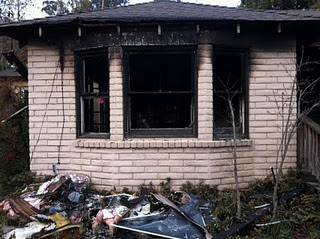
Nobody was home on Friday when the fire broke out in the first floor bedroom. By the time Patricia and LaToya got back home, the fire department had already come and gone. The entire inside of their house was black from the ashes and dank from the layer of watery mucus streaked with boot prints covering the floor. The bedroom ceiling had been gutted and light from the exposed gash provided the only source of light on the piles of splintered wood and overturned furniture now mangled into unrecognizable heaps.

Patricia and LaToya were still reeling from the shock of what had happened to their home when volunteers from the Red Cross Disaster Action Team (DAT) arrived on scene. The group walked through the sisters’ West 61st Street home, taking in the extent of the wreckage in silence. Patricia’s two children, a 14 year-old daughter and a 13 year-old son, were at school-- thank goodness for that at least-- but where were their medical cards? To assess how the Red Cross was going to help her family, the volunteers needed to verify who lived inside the house. All Patricia could find was the trunk where the children's medical cards were located—and they weren’t in there now. Angela, a social work intern on the Disaster Action Team, tried to calm her down and told Patricia the Red Cross will give her time to retrieve copies of any documents she needed. Halfway through the interview, Patricia was finally able to locate her medical cards.

The fire in Patricia’s home probably started spontaneously from faulty electrical wiring--there was no way anyone could have predicted what would happen as they left the house on that fateful morning. By the time the family got back, things were so chaotic, physically and mentally, that the simple act of piecing together a coherent picture of life before the fire became fraught with anxiety. Witnessing Patricia’s stress while trying to account for the identity of her children popped all sorts of questions about the safety of my own records at home: Sure, I kept this letter in the yellow folder in that drawer--but would I be able to find it if that room got wrecked? Would there even be anything left to find?

Suddenly I realized how vulnerable we all are to losing our identity. How even more critical those bits of cards and paper become in the immediate aftermath of an attack on our homes. It was a stroke of good luck that nobody was inside when the fire broke out in Patricia’s house, but it also meant that trying to regroup in the wake of all that destruction became that much harder. The last thing you want to worry about when your house lays tattered before you is trying to prove you actually live there. That’s why Angela counsels carrying some documentation verifying your home address at all times. An old bill or a cancelled check tucked into the back of a wallet could turn out to be the small sliver of relief amidst a day of loss and disorientation.


Written by: Christine Li


Monday, October 24, 2011

Frayed Wires Cause Fires


Yamina and Amira stayed home from school last Wednesday with a shared case of pink-eye. Chiquita, their guardian, was at work when the two girls smelled smoke coming up through the vents, and heard the alarms blaring. They ran downstairs and started pounding on the door.
Chiquita rents the second-floor apartment from an elderly woman who lives downstairs with her son and caretaker Jerry. He was taking a midday nap, but the smoke alarms, and perhaps the girls pounding on the door, jolted him awake.

With the overwhelming stench, Jerry knew this wasn’t a false alarm. He swung open the basement door, and smoke poured out as if from a chimney. He couldn’t see a thing, and in the split second before dialing 9-1-1, Jerry mourned the probable death of the three pet turtles he kept in an aquarium downstairs.

The fire department appeared in seconds, and after putting the fire out, they showed Jerry where it all started: the downstairs refrigerator was plugged in to an extension cord, and when it sparked, the surrounding woodwork shot up in flames.

“It was plugged in like that for 50 years,” Jerry said. “I had no idea it was a problem.” The firefighters explained to Jerry that large appliances like refrigerators must be grounded—plugged into a three-prong outlet or power strip—and that electrical cords should be checked routinely, and replaced if frayed. Electrical fires are one of the leading causes of home fires. The U.S. Fire Administration provides tips for preventing these fires.

Jerry was down about the destruction caused by the fire, though he was glad that most of his and his mothers’ possessions were only tainted with the smell of smoke. “We’ve got 50 years’ worth of stuff down there,” he said. He still wore a smile, though: all three turtles survived.

Volunteers from the Red Cross were able to provide food and shelter to the people affected by this fire. Home fires are so commonplace that they often go unnoticed by the media, but they happen 2 to 3 times a day, every day in Chicagoland.

Make sure to inspect your home for fire hazards, and be active in preventing them. See the USFA page on home fire prevention, and our page on fire safety. The Red Cross offers a fire prevention program, Team Firestopper, which provides education and fire prevention activities in communities that are disproportionately affected by home fires. Team Firestopper volunteers conduct home hazard hunts to identify issues like this one before they cause destruction. For information about volunteering with Team Firestopper or to sign up for a visit to your home, go to http://bit.ly/al25l7.


Written by: Jonathan Bressler

Monday, October 17, 2011

Starting Over: Former Red Cross Intern Shares his Recovery Story


Last Christmas, Zach Zimmerman, a former Red Cross intern, found himself in a similar position as the families he helped during his time here. His family was victim to a home fire sparked by a space heater. Now, 10 months later, Zach reflects on the process of recovery and how his experience at the Red Cross helped him get through the hard times.

It has been a long road for Zach’s family from the day the fire occurred to when his house was finally rebuilt. The weeks following the fire and Zach’s first encounter with his childhood home were particularly difficult, “Walking through the house, I'd see things from my childhood that were extremely sentimental and the remains of what my mom had worked so hard to create for us: a home.”

Eventually, his family regained hope that they could successfully pick up the pieces and rebuild their lives. “As new hardwood floors went in, debris and glass was taken out of the yard and a fresh coat of paint was applied, I found myself excited to move back in,” Zach said. “This fire helped me put a myriad of things into perspective. Things are really just things, and nothing comes to being more important than your family.”

Zach stressed the importance of a strong support system when going through a traumatic experience. Family and friends can be the rock you need for long term recovery. “Whether it’s helping you sort through the rubble, or simply taking you out for a much needed day of fun, your family and friends are the best healing doctors in the world.”

As Red Cross interns, we are able to accompany teams when they respond to actual home fires that occur in the greater Chicago region to help communicate with the families and see them through the disaster. Zach and I have both been on the scene while families cope with disaster. When I asked how his time at the Red Cross helped him recover he said, “With the experience seeing others deal with the devastation of a fire under my belt, talking to my family about the fire was easier for me. I knew what they needed to hear, and I also knew how to help them realize the positives in the situation.”

It is crucial to get a kit, make a plan, and be informed. Through this disaster, Zach and his family learned the importance of being prepared first hand. “We have created an emergency evacuation plan to be prepared if something like this ever happens again. It's critical that everyone knows what to do in a situation like that. Being prepared can only benefit you, so take the time to make sure you're ready to act when a disaster happens.”

The American Red Cross offers immediate support after a disaster, but long term recovery is equally important. For more on Zach’s experience, read his blog post.

Written by: Katie Donabedian